Thursday, April 22, 2021

pandemic mental health side effects

i listened to the WHO interview with a mental health specialist & this is what I gathered to be the factors triggering anxiety & depression in the current covid-19 pandemic we're experiencing for a year now:

>isolation

>fatigue

>UNCERTAINTY

>disruption of routine

>people, including family members, getting sick of the virus

>grief over the loss of a loved one

my reflection:

it's like an ACE (adverse childhood experience) wherein we regress back to our HELPLESS childhood experience and the parents who are supposed to be pillars of SAFETY & SECURITY are themselves UNSAFE & INSECURE & SCIENCE (& technology) that is supposed to have all the ANSWERS do NOT have them & are INCAPABLE of fighting this virus that has mutated into various strains & difficult to follow with the vaccines that have been developed.

our ultimate anchor: GOD, the ALMIGHTY (Omnipotent, Omniscient, Omnipresent), the IMMUTABLE, UNCHANGING, ENDLESS LOVE. this time is a time to re-discover the God of the impossible, as shared by fr domie guzman, ssp in his homily today. his prayer is: "Lord, STOP this pandemic because we know (in faith) that You can do it, You only have to say it & it will happen!"

 

vertical splitting

in psychoanalytic tradition:

1. horizontal splitting: repression

2. vertical splitting: denial (wikipedia)

i counseled this couple with the wife with bipolar disorder reacting to the point of wanting to separate from husband. fortunately, being an atheist (which may not be relevant to this statement), she uses logic in making decisions (also aware of her mood swings) by consulting people. having been a previous counselee of mine, she decided to seek my counsel.

wife used vertical splitting as a reaction formation for having a neglectful father. thus, she IDOLIZED this husband with whom she was not attracted but learned to love because he was "everything" his father was not... until she found out he had a sexual misconduct with a previous relation PRIOR to their romantic relationship.

========================================================================

vertical splitting example from the internet:

service user to therapist in group psychoanalytic psychotherapy: "when you talk to me this way about my YOUTH, i acknowledge in some sense the TRUTH in what you are saying, yet still i think, is this me? it is as if aspects of me & my PAST are UNREAL & have to be MIRRORED by others before i can own them myself."
========================================================================
source: Wikipedia sv. splitting (psychology)

>aka "black-and-white" or "all-or-nothing" thinking

= "the failure in a person's thinking to bring together the DICHOTOMY of both POSITIVE and NEGATIVE qualities of the self and others into a COHESIVE, REALISTIC whole"

= "a defense mechanism by which people with borderline personality disorder can view people, events, or even THEMSELVES in ALL-OR-NOTHING terms" (verywellmind.com)

>discovered by RONALD FAIRBAIRN -- Object Relations Theory: the infant is unable to combine the FULFILLING aspect ("good object") and the unresponsive aspect ("bad object") of the PARENT into the SAME individual

>in relationships, this can be PERSONIFIED VIRTUE or VICE at different times; i.e., the other is ALL GOOD if need is satisfied, but ALL BAD if unsatisfied

>Borderline Personality Disorder = "a pattern of UNSTABLE & INTENSE interpersonal relationships characterized by alternating between EXCESS of IDEALIZATION (+) and DEVALUATION (-)"
========================================================================

therapy application: "in order to help one's patients, one needs COURAGE to enter their difficult terrain where troubled parts of oneself still remain...."
  

Monday, April 19, 2021

"deep-seated" vs "transitory" homosexuality in seminarians

 https://www.tandfonline.com/doi/pdf/10.1179/002436311803888302?fbclid=IwAR2iAKliwznrWINXUytphyoGN5XaCS1MVdllilY-thChHgyaoFWSKr0h6rA&

Friday, April 16, 2021

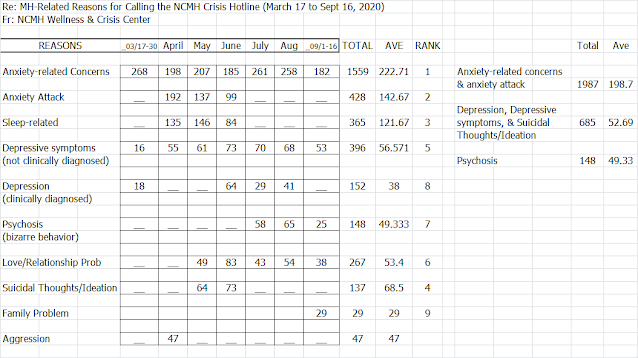
PH stats on MH during the covid-19 pandemic

https://www.gmanetwork.com/news/news/nation/780177/suicide-rate-up-25-7-in-2020-says-psa/story/?utm_source=GMANews&utm_medium=Facebook&fbclid=IwAR1q2-hDIzmAuuD7lBq4xNMwmkVu8dYiMBZVeD-FI7wWUzdsj0Hhb3S4M4g 

Fr: GMA News published 03/18/2021 1:18 PM

1. deaths due to "intentional self-har" = 3,529 (2020) [2th leading cause of death] vs. 2,808 (2019) [30th leading cause of death] -- PSA (PH Statistics Authority)

2. 28% Filipinos experienced emotional problems like stress or extreme sadness due to the pandemic -- OCTA Research (01/26-02/02/2021 data gathering period)

3. 53 suicide-related calls / [month] at the NCMH crisis hotline -- DOH (2020 Aug)

collated by me based on data provided by NCMH Crisis Hotline 

Monday, March 29, 2021

narcissism

re: 3 signs you're in a toxic relationship

fr: fb story of amber eve

1. they DON'T CARE about your feelings.

2. they want you to make them a priority, but they won't make you a priority.

3. it is difficult to communicate with them, either because you're AFRAID of their reaction or you know they really DON'T CARE what you have to say.

Saturday, March 13, 2021

suicide prevention (nimh)

https://www.nimh.nih.gov/health/topics/suicide-prevention/index.shtml

Signs and Symptoms

The behaviors listed below may be signs that someone is thinking about suicide.

  • Talking about wanting to die or wanting to kill themselves
  • Talking about feeling empty, hopeless, or having no reason to live
  • Making a plan or looking for a way to kill themselves, such as searching for lethal methods online, stockpiling pills, or buying a gun
  • Talking about great guilt or shame
  • Talking about feeling trapped or feeling that there are no solutions
  • Feeling unbearable pain (emotional pain or physical pain)
  • Talking about being a burden to others
  • Using alcohol or drugs more often
  • Acting anxious or agitated
  • Withdrawing from family and friends
  • Changing eating and/or sleeping habits
  • Showing rage or talking about seeking revenge
  • Taking great risks that could lead to death, such as driving extremely fast
  • Talking or thinking about death often
  • Displaying extreme mood swings, suddenly changing from very sad to very calm or happy
  • Giving away important possessions
  • Saying goodbye to friends and family
  • Putting affairs in order, making a will
  • If these warning signs apply to you or someone you know, get help as soon as possible, particularly if the behavior is new or has increased recently.

    ======================================================================

    https://www.nimh.nih.gov/health/publications/5-action-steps-for-helping-someone-in-emotional-pain/index.shtml

    Here are 5 steps you can take to #BeThe1To help someone in emotional pain:

    1. ASK: “Are you thinking about killing yourself?” It’s not an easy question but studies show that asking at-risk individuals if they are suicidal does not increase suicides or suicidal thoughts.
    2. KEEP THEM SAFE: Reducing a suicidal person’s access to highly lethal items or places is an important part of suicide prevention. While this is not always easy, asking if the at-risk person has a plan and removing or disabling the lethal means can make a difference.
    3. BE THERE: Listen carefully and learn what the individual is thinking and feeling. Research suggests acknowledging and talking about suicide may in fact reduce rather than increase suicidal thoughts.
    4. HELP THEM CONNECT: Save the National Suicide Prevention Lifeline number (1-800-273-TALK) and the Crisis Text Line (741741) in your phone so they’re there if you need them. You can also help make a connection with a trusted individual like a family member, friend, spiritual advisor, or mental health professional.
    5. STAY CONNECTED: Staying in touch after a crisis or after being discharged from care can make a difference. Studies have shown the number of suicide deaths goes down when someone follows up with the at-risk person.

    For more information on suicide prevention: www.nimh.nih.gov/health/topics/suicide-prevention.

    ======================================================================hhttps://www.nimh.nih.gov/health/topics/suicide-prevention/index.shtml#part_153178

Risk Factors

Suicide does not discriminate. People of all genders, ages, and ethnicities can be at risk. Suicidal behavior is complex, and there is no single cause. Many different factors contribute to someone making a suicide attempt. But people most at risk tend to share specific characteristics. The main risk factors for suicide are:

  • Depression, other mental disorders, or substance abuse disorder
  • Certain medical conditions
  • Chronic pain
  • A prior suicide attempt
  • Family history of a mental disorder or substance abuse
  • Family history of suicide
  • Family violence, including physical or sexual abuse
  • Having guns or other firearms in the home
  • Having recently been released from prison or jail
  • Being exposed to others' suicidal behavior, such as that of family members, peers, or celebrities
  • Many people have some of these risk factors but do not attempt suicide. It is important to note that suicide is not a normal response to stress. Suicidal thoughts or actions are a sign of extreme distress, not a harmless bid for attention, and should not be ignored.

    Often, family and friends are the first to recognize the warning signs of suicide and can be the first step toward helping an at-risk individual find treatment with someone who 

    specializes in diagnosing and treating mental health conditions. See the resources on NIMH’s Find Help for Mental Illnesses page if you're not sure where to start.

    Suicide is complex. Treatments and therapies for people with suicidal thoughts or actions will vary with age, gender, physical and mental well-being, and with individual experiences. NIMH has focused research on identifying people at risk for suicide and identifying effective interventions.

    ======================================================================

https://www.nimh.nih.gov/health/topics/suicide-prevention/index.shtml#part_153178

TREATMENT  & THERAPIES

A. Brief Intervention

1. Safety Planning

a. (-) Limit access to lethal means, e.g. firearm, pills, or poisons

b. (+) Teach coping strategies & resources when in crisis

2. Follow-up Phone Calls

NB: Research shows that when at-risk patients receive further SCREENING, a SAFETY PLAN intervention, and a series of SUPPORTIVE PHONE CALLS, the risk of suicide is decreased.

B. Psychotherapies (Psychosocial Intervention)

1. CBT (Cognitive Behavioral Therapy)
a. [T] Recognize thinking pattern
b. [A] Consider alternative actions

2. DBT (Dialectic Behavioral Therapy)
a. [T] Recognize disruptive or unhealthy feelings & actions
b. [A] Teach SKILLS needed to deal with upsetting situations

NB: Research has found that DBT reduces suicide risk among adolescents and adults with borderline personality disorders (= ongoing patterns of varying moods, self-image, & behaviors that often lead to impulsive actions and problems in relationships)

C. Medication

CLOZAPINE is the only antipsychotic medicine with US FDA indication for reducing risk of recurrent suicidal behavior in patients with schizophrenia or schizoaffective disorders.

D. Collaborative Care
A team-based approach composed of (1) a care manager, (2) the primary care provider, (c) the patient, and consulting with a (d) mental health specialist, e.g., psychiatrist or psychiatric nurse.


NB: Many individuals at risk for suicide often have a mental illness and substance use problem.

Sunday, November 1, 2020

the highly sensitive person (elaine aron, phd, 1996)

Re: “The Highly Sensitive Person (HSP)”

Fr: Dr. Elaine Aron (1996) https://hsperson.com/test/highly-sensitive-test/


--also scientifically called “Sensory-Processing Sensitivity” (SPS)

--15-20% of population


>easily overwhelmed by strong SENSORY INPUT

>seem to be aware of subtleties in my environment

>other people’s MOODS affect ME

>tend to be very sensitive to PAIN

>need to WITHDRAW during busy days, to have some privacy & relief from stimulation

>particularly sensitive to the effects of CAFFEINE

>easily overwhelmed by things like bright LIGHT, strong SMELLS, coarse FABRICS, OR SIRENS close by

>has rich, complex INNER LIFE

>made uncomfortable by loud NOISES

>deeply moved by the ARTS or MUSIC

>NERVOUS SYSTEM feels so frazzled that I just have to go off by myself

>conscientious

>STARTLE easily

>get RATTLED when I have a lot to do in a short time

>tend to know what needs to be done to make an uncomfortable physical environment COMFORTABLE (e.g. light or seating)

>annoyed when people try to get me to do too MANY THINGS at once

>try hard to avoid making MISTAKES or FORGETTING things

>avoid VIOLENT movies and TV shows

>unpleasantly AROUSED when a lot is going on around me

>being very HUNGRY creates a strong reaction in me, disrupting my concentration or mood

>CHANGES in my life shakes me up

>notice & enjoy DELICATE or FINE scents, tastes, sounds, works of ART

>find it unpleasant to have a LOT going on at once

>high priority to ARRANGE my life to avoid upsetting or overwhelming situations

>bothered by INTENSE STIMULI, like loud noises or chaotic scenes

>when I must COMPETE or be OBSERVED while performing a task I become so nervous or shaky that I do much worse than I would otherwise

>as a child, my parents or teachers seemed to see me as SENSITIVE or SHY


Scoring: >14 = probably HSP